Sun, moon, and stars coloring pages for dreamy night space scenes
Inside this collection, you'll find printable scenes that mix glowing suns, crescent moons, full moons, shooting stars, sleepy clouds, constellations, and patterned celestial faces. Some pages keep the shapes big and friendly for preschoolers who are practicing broad coloring strokes, while others add tiny star fields, crater details, rays, swirls, and mandala-style borders for older kids, teens, and adults. The set works well for space lessons, bedtime-themed art, classroom quiet time, or anyone who likes the calm look of the night sky with a bright touch of sunshine.
Sun Moon Stars pages by style, mood and season
Fun facts to share while coloring
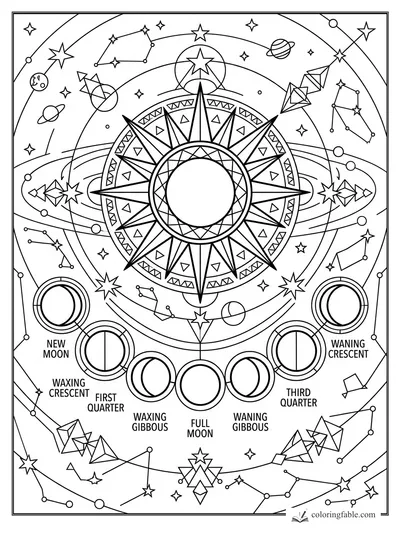
The Sun is a star, and it is by far the closest star to Earth. Its light reaches us in about 8 minutes and 20 seconds, which means sunlight has already traveled millions of miles before it lands on your paper. The Moon does not shine on its own; we see it because it reflects sunlight. As the Moon orbits Earth, we see different lit portions, creating phases from crescent to full moon over about 29.5 days. Stars can look white, yellow, orange, red, or blue because their colors are linked to temperature; blue stars are generally hotter than red stars.
Coloring tips
For a classic sun, moon, and stars palette, build the Sun with lemon yellow, golden yellow, orange, and touches of red at the ray tips. Use ivory, pearl gray, silver, charcoal, and soft blue-violet for the Moon, especially inside craters and along the shadow edge. Stars pop in white, pale yellow, icy blue, and lavender against a sky of navy, indigo, deep purple, or black. Try blending outward on sun rays, then use small circular shading or stippling for moon craters. For a theme-specific twist, split one page into daytime and nighttime halves, with the Sun's rays fading into a constellation-filled sky around the Moon.